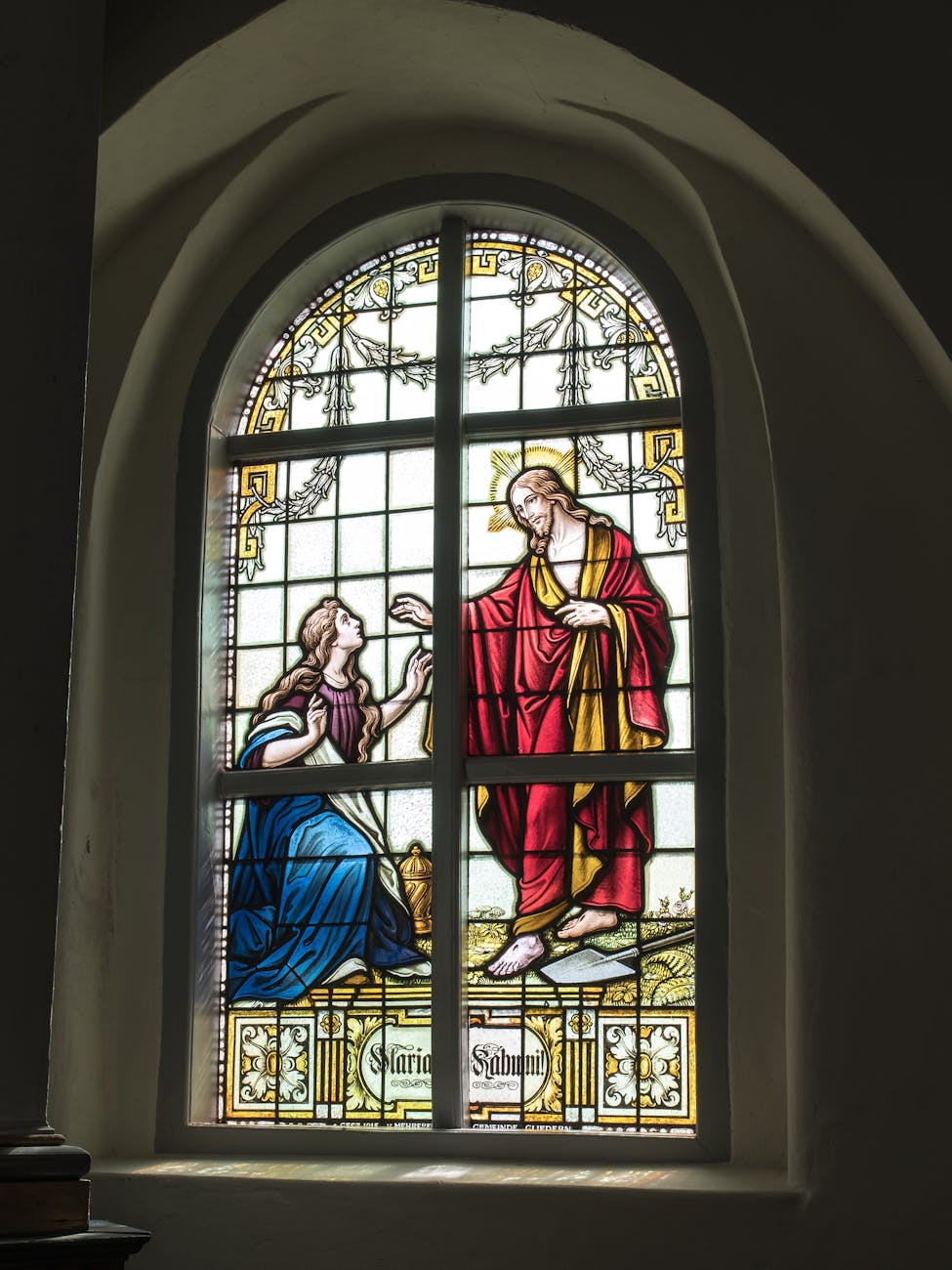
Few biblical stories are more familiar to Christians than that of Easter. Most of us may not be able to remember which of the Synoptics describes two angels at the tomb versus one, but John’s account of that holy morning is quite distinctive. In the Fourth Gospel, it is one woman, Mary Magdalene, who discovers the empty tomb. She runs to tell the disciples, and Peter and “the disciple whom Jesus loved” race to the tomb—ostensibly leaving Mary to follow behind.
When the two reach their destination, the beloved disciple is reticent to enter the empty tomb. Characteristically, Peter shows no hesitation, jumping in before he has any clue what’s going on. When the beloved disciple does enter, we are told that “he saw and believed” (John 20:8), but in the same breath, “for as yet they did not understand the scripture, that he must rise from the dead” (v. 9). We do not know what the beloved disciple believed, but it surely wasn’t the full picture, and he doesn’t seem to tell anyone about it.
We must wonder if these two simply walk past the weeping Mary on their way to “return to their homes” (v. 10).
Perhaps Mary’s stolid determination to remain at the tomb, to look into the maw of death (though she first hesitated), to try to grasp the situation, is what summons the two bright angels (v. 12). She is still asking the wrong questions, looking for the Lord in the wrong place. Yet even in her confusion, she is seeking Christ in love. Many a Christian will testify that those who seek this way, with aching want and misunderstanding, will find: “…a broken and contrite heart, O God, you will not despise” (Psalm 51:17b).
Like so many of us, Mary Magdalene does not recognize Jesus when He appears to her. She has turned away from the angels to look for Him—isn’t it profound that she is hardly fazed by the presence of these shining divine messengers?—finds Him, but does not recognize Him. Again, she is asked why she is crying. Granted, Jesus asks a second, more pointed question: “For whom are you looking?” (John 20:15). This question intensifies the irony of her non-recognition, but it is also compassionate. He is leading her gently toward realizing the true object of her quest.
Again, she answers that her Lord is gone. In line with the Lord’s question, she refers to Jesus, not his body. She believes Him to be dead, but has come to honor Him by performing the rituals of death, anointing the One who was spit upon, restoring care to the One who was put to the most shameful death. She believes that the powers of empire have taken His life away, but that she can still do something for Him if she can only find Him.
In speaking to Jesus (whom she presumes to be the gardener (v. 15)), she does another odd thing we should notice. Instead of asking the “gardener” to bring Jesus back if he has moved Him, she simply asks that he point her in the right direction so that she can bring Him back. Now, the Gospels do not provide a physical description of Jesus or of Mary Magdalene. However, unless Jesus was extremely petite or Mary was a power lifter, it seems unlikely that she would have been able to carry His lifeless body back to the tomb. Maybe this demonstrates that in her grief, she either disconnected a bit from physical reality or simply ceased to care. I think it was probably both.
Here comes the really good part: Jesus calls her name. Most obviously, this action demonstrates that He is not a stranger, but a friend. In addition, it harkens back to Jesus’s earlier words that the sheep recognize the voice of the shepherd, who calls them by name (John 10:3-4). It is in this same passage that Jesus proclaims, to the consternation of many listeners, “…I lay down my life in order to take it up again” (v. 17). His closeness with and love for the sheep are bound up with His willingness to die for them, which is itself bound up with His resurrection.
Third, though the English translation does not represent this, we notice in the original Greek that Jesus does not call Mary by her usual name, transliterated as “Maria.” Instead, He calls her “Mariam” (John 20:16)—which is the spelling of “Miriam” in the Greek version of the Hebrew Bible. He is calling her a name that connects to their culture. He is calling her a new name known only to Him and her (see Revelation 2:17). Poignantly, He is connecting her to the figure in Exodus, the sister of Moses, who watches him as he floats down the river, protects him, even approaches the Pharaoh’s daughter to suggest that she return him briefly to the woman who is in fact their mother so he can nurse.
Mary Magdalene has watched Jesus, the fulfillment of Mosaic law, the One chosen to lead all people out of slavery and into the promised land, as He floated down the river of death. She has stood in quiet confrontation with the empire by standing at the foot of the cross. Now she has come to anoint His body, but instead, by bringing the news of His resurrection to His loved ones, she will bring Him alive back to his mother.
Upon hearing these words, the scripture says, she turns to Him and calls Him by a Hebrew name in return: “Rabbouni” (John 20:16). But wait—hadn’t she already turned? Didn’t she turn away from the tomb, and in doing so, see “the gardener”? What is this response to Christ’s calling of her (new) name? What is this second turn?
Mary’s first turn is physical. With it, she ceases to look for the living among the dead (see Luke 24:5). This first turn is away from the dead end of the tomb to the One who is the Way, the Truth and the Life. It is in fact a turn to Christ.
Her second turn is spiritual. With it, she sees and believes that Christ has risen from the dead. She recognizes Christ in front of her. She is abruptly made aware, through a loving call, of a salvation already won for her.
Perhaps the first turn for many in Christian life is baptism. In it, we reject death and are reoriented toward life. However, especially if we are baptized as infants, we may not yet understand our salvation. Even those of us who come to Jesus as adults may not realize the full meaning of grace when we receive it. We may not yet be adept in recognizing Jesus.
I venture to say that we experience our second turn, to greater or lesser degrees, many times over. This second turn is initiated by God, who calls our name in a way we’ll recognize, who carries the sheep back to the fold. It is an internal re-turning of a heart which, though already saved, is terribly forgetful. We are always already standing before the Lord. Yet, it takes a rotational miracle to convince us He’s alive.
Even Christ’s death and resurrection could be seen as a first and second turn made on our behalf. On the cross, He redeems the world. But the resurrection is not just proof of death’s defeat, nor is Christ’s residence on earth before the Ascension just a victory lap. In Easter we find divine grace catching us up, sweeping us up, into what God has already done. The living Christ brings us not only to see and believe but to understand and to recognize. Ultimately, it is the awareness of our heavenly salvation that allows us to live into it on earth.
In this Easter season and always, may we have the grace to recognize the living Christ everywhere we go. Amen.

Leave a comment