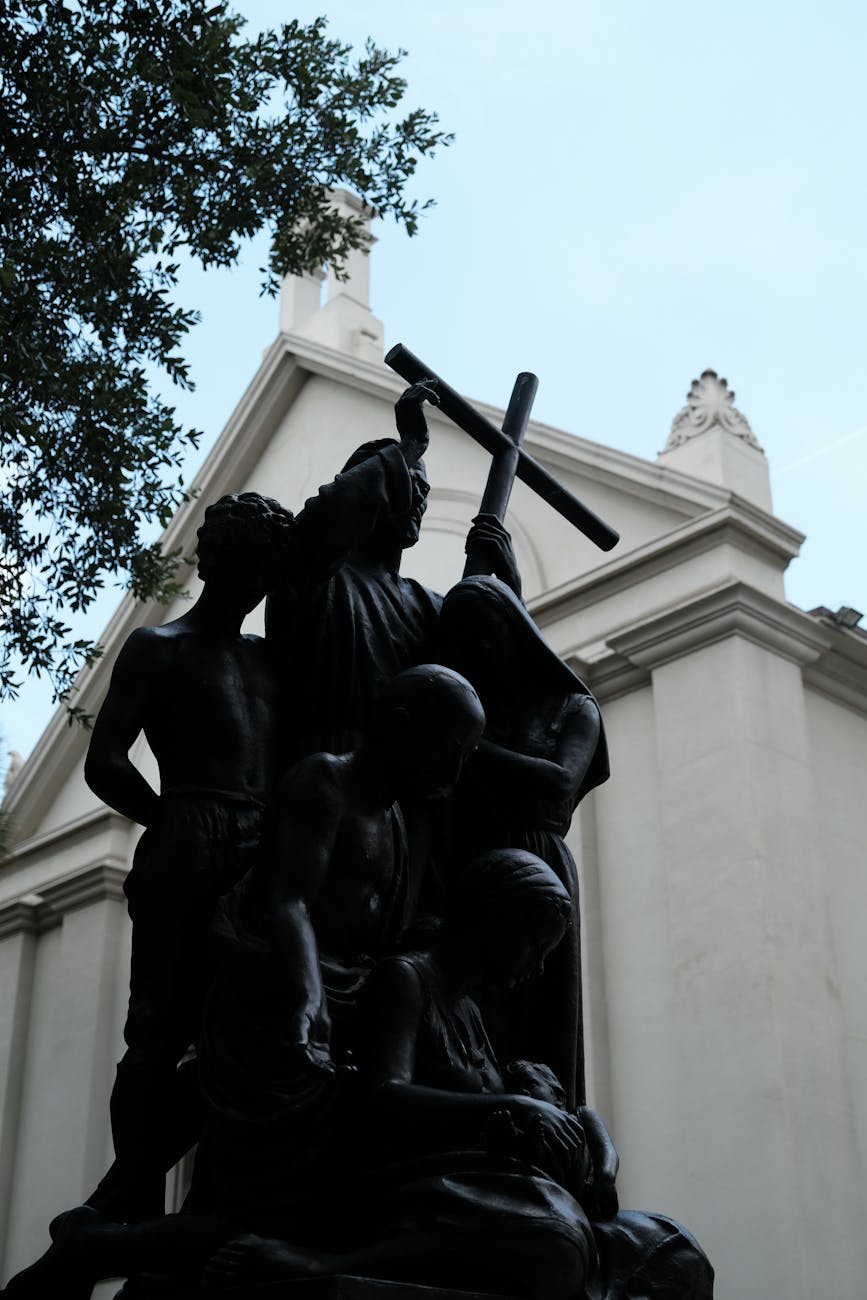
For many American Christians, it’s not Christmas without “Silent Night.” It’s not Easter without “Christ the Lord Is Risen Today.” And it’s not Good Friday without “Were You There When They Crucified My Lord.”
The latter hymn, one of the most poignant and recognizable in the hymnals of countless denominations, is an African-American spiritual, thought to have been composed by enslaved people on the plantations of the American South.1 This anthem arises from the depths of the grave sin of slavery to praise the one who takes away the sin of the world.
The lyrics of the first verse as found in Old Plantation Hymns (1899) are:
Were you there when they crucified my Lord? (Were you there?)
Were you there when they crucified my Lord?
Oh! sometimes it causes me to tremble! tremble! tremble!
Were you there when they crucified my Lord?
The next three verses add, “Were you there when they nail’d him to the cross?”; “Were you there when they pierced him in the side?”; and “Were you there when the sun refused to shine?” The refrain of the third line remains constant: “Oh! sometimes it causes me to tremble! tremble! tremble!”
In the internet age, we are constantly bombarded with news from all corners of the world. We start to become numb to it all, an understandable and perhaps necessary defense mechanism. Working in a hospital, I have started to find calluses on my heart, spots that used to be tender but are now inured to shock and pain. When there is so much suffering around us, we cannot feel it all. But this leads me to an important question: What does cause us to tremble?
On Good Friday, we may fool ourselves into thinking that we only need to tremble for a couple of days, because Easter is sure to come. Perhaps we become tempted to write off Good Friday altogether, because Christ is victorious in the end—why dwell on the agony, the nails and the sword? But the people who created this hymn knew all too well that the fullness of God’s victory still awaits. We have yet to see the day when God will wipe every tear from our eyes (Revelation 21:4). Justice will roll down like water (Amos 5:24), but for now, so many languish in the desert.
Jesus died the death of a slave. He died at the hands of a brutal empire, and was delivered to them by religious authorities and his own friend. The crucifixion is personal, but it is also social and societal. It is not just individual sin and betrayal, but systemic injustice made painfully manifest in the destruction of one man’s body. The very cosmos responds to the outrage: as the hymn says, “the sun refused to shine” (see Mark 15:33).
Jesus’s salvific death and resurrection were unique. These will never be repeated. But the type of suffering he endured still haunts us; it is all but routine. It happens in quick and dramatic ways, such as bombings with their “collateral damage.” It also occurs in slow, grinding ways, such as poverty, racism, heterosexism, xenophobia, and other forms of oppression that erode people’s lives, both physically and spiritually.
Crucifixion is the diabetic who slips into a coma because they couldn’t afford insulin. Crucifixion is the child deprived of food. Crucifixion is the immigrant stripped of their clothes and their will to live by the inhumanity of detention.
This song and the passion narrative in general emphasize the meaningfulness of presence. But the song, having been written well after the first century CE, is for those who were not there when Jesus was crucified. Still, it testifies, we tremble. We do not have to be face-to-face with the sufferers to act in compassion.
There is a role for everyone in the Good Friday story. We all, in our mundane cruelty, are the ones nailing Jesus to the cross. We are the ones betraying and denying him.
But perhaps we can also be Simon of Cyrene, helping carry the cross (Mark 15:21). Perhaps we can be the women along Jesus’ path to Golgotha, weeping for him (Luke 23:27). Perhaps we can be the “women looking on from a distance,” the ones bearing witness, even from afar, “who followed [Jesus] when he was in Galilee and ministered to him” (Mark 15:40-41). Perhaps we can be the Marys and John at the very foot of the cross (John 19:25). Perhaps we can be Joseph of Arimathea, using our influence to preserve the dignity even of the dead (John 19:38). Perhaps we can be the women at the tomb, bringing care to a space of darkness and finding light instead.
The laborers. The mourners. The witnesses. The comforters. The influencers. The caretakers. There are opportunities for all of us to be faithful, to be there.
So do not let Good Friday be only a day to reflect on personal sin. Individual choices matter greatly, but it was an empire, not an individual, that crucified Jesus. Make time this Holy Week to look with tender eyes and see the crucifixions, loud and quiet, abrupt and slow, happening all around us. Allow yourself to tremble. Then, when Sunday morning comes, may the news of the resurrection bring us the hope we need to rise again.
- Raymond F. Glover (1990). The Hymnal 1982 Companion. Church Publishing. p. 349. ↩︎

Leave a comment