Category: Uncategorized

  • To Know the Spirit of Abiding Love: Part 4

    To Know the Spirit of Abiding Love: Part 4

    In the unfortunate event that I have failed to make these posts less boring than my master’s thesis, you may be relieved to hear that this is the final instalment of my series on the Holy Spirit in 1 John and the Farewell Discourse. I hope, though, that I’ve been able to illustrate a bit of why I believe that the first letter of John bears a truly exciting witness to the Spirit. I hope you’ll come to agree that it tells us something substantial and precious about that mysterious person of the Trinity who challenges us, if you will, with “a problem like Maria…How do you hold a moonbeam in your hand?”

    In 1 John 4, we will be invited to see lines drawn between ideas like stars in a constellation—Spirit, abiding, and love. In the Farewell Discourse, these fiery words studded the dark backdrop of Jesus’ impending death; here, they are meaningfully aggregated such that a unique way of understanding each point of light, and the Spirit’s self, begins to take shape.

    At the end of 1 John 3, we heard that the love God commands is, like Jesus, veiled in flesh. The love that pleases the Divine, the death-defying love which only a cruciform power could give, shows up most frequently in the mundane. God has made us capable of this love and will continue dispel from our hearts the shame that inhibits it. Yet, our assurance comes not only from our observable actions, but from God’s intangible gift: “And by this we know that he abides in us, by the Spirit that he has given us.” (3:24).

    1 John 4 continues the theme, emphasizing Christ’s embodiment (4:2) and further specifying the reciprocity of divine-human abiding: “By this we know that we abide in him and he in us, because he has given us of his Spirit” (4:13). Recall Christ’s various statements in the Farewell Discourse that he, we, the Father and the Spirit either love, abide in, or abide in the love of each other!

    Of course, the letter is clear that God is the source of love: “In this is love, not that we loved God but that he loved us and sent his Son to be the atoning sacrifice for our sins” (4:10; see also 4:19 and Romans 5:5-8, another famous Spirit-love passage!). Yet, on the other side of Christ’s death and resurrection, we are empowered to love God in a new way: “So we have known and believe the love that God has for us. God is love, and those who abide in love abide in God, and God abides in them” (4:16).

    We know our mutual abiding with God by the manifestation of the love command and by the gift of the Spirit; the identity of God, and therefore the content of abiding, can be understood as love. Confession of Christ’s embodiment is the mark of the Spirit of God (4:2); Christ’s embodiment is proof of God’s love (4:9-10), and our love must also be embodied (4:21). This letter passionately proclaims a Christ-theology of divine sonship and atoning sacrifice, with ethics to match. Meanwhile, it gently implies a Spirit-theology of abiding love.

    This letter doesn’t try—if you’ll excuse one more Sound of Music reference—to “catch a cloud and pin it down.” Instead, it points out a constellation and invites us to stargaze. It offers a deeply comforting perspective to a fractured, wavering, abandoned church: the divine Spirit of love, though ungraspable, remains.

  • To Know the Spirit of Abiding Love: Part 3

    To Know the Spirit of Abiding Love: Part 3

    This post is the third in a poorly spaced-out series on the Holy Spirit in 1 John and the Farewell Discourse. So far, we have discussed the boringness of my master’s thesis, the unfortunate scholarly implication that 1 John is boring too, and the crystal clarity of undying, willing-to-die love in Jesus’s final teachings. Now, we move to the crossover between the Discourse and the epistle, which I contend will begin to demonstrate how electrifying the latter truly is.

    Upon reading John 13-17, we find several words repeated like a drumbeat: Father, Son, Spirit, commandment, truth, completeness, love, abiding. 1 John is interested in the same things: who is God? What does God command? How can we understand the truth? How can our community be whole and joyful? The epistle leads its readers to one Being as the locus of mystery and faith. It leads to the Spirit of abiding love.

    In 1 John 3:11-24, the author expounds upon the primacy and true meaning of love. It can hardly be a coincidence that this passage contains overlap with the Farewell Discourse, is laden with language of abiding, and culminates in the Epistle’s first explicit reference to the Spirit.

    Echoing the notion of tangible revelation found in 1 John 1:1—“We declare to you what was from the beginning, what we have heard, what we have seen with our eyes, what we have looked at and touched with our hands, concerning the word of life”—and the proclamation of gratitude, awe and confidence of verse 3:1—”See what love the Father has given us, that we should be called children of God; and that is what we are”—verse 3:11 begins, “For this is the message you have heard from the beginning, that we should love one another.”

    Reading these verses together and in the context of what the latter has taught so far, we begin to move toward the identification of God with love. Christ, God Incarnate, who “emptied himself, taking the form of a slave” and was “obedient to the point of death— even death on a cross” (Philippians 2:7-8), is Himself “what was from the beginning” (1 John 1:1; cf. John 1:1). Christ is the Word, the Message. Yet, in 1 John 3:11, communal love is said to be the original message. Real, touchable, flesh-and-blood Jesus and real, active, meet-your-neighbors’-needs love are inseparable. As we saw in the Farewell Discourse, to love is to be with Christ.

    1 John 3:16 represents a more exact overlap between the texts: “We know love by this, that he laid down his life for us—and we ought to lay down our lives for one another.” John 15:13 uses the image of laying down one’s life to represent the highest form of love (see also 13:34-38); here, the author of the Epistle uses the same language to describe Christ’s actions for the believers, then expands this to an ideal for their community. The Epistle does what the Farewell Discourse, set before the crucifixion, cannot: it explicitly defines the love in terms of Christ’s crucified flesh and blood.

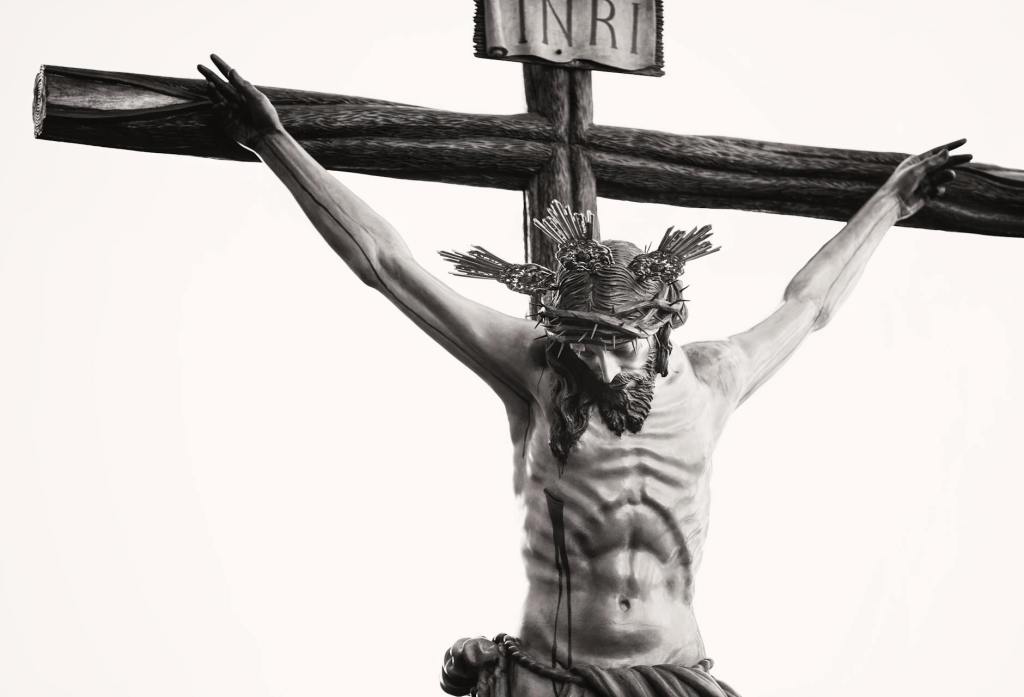
    So far, the letter has been insisting that the meaning of the Gospel is not just ethereal, flowing whispers in the wind. It is not just feeling and mysticism, as the secessionists may have claimed. The Gospel hinges on the fact that God became incarnate through a young unmarried woman, walked around in Nazareth, ate, drank, washed the dust off of his friends’ feet, died a real and horrific death, and rose again. Our response to the Gospel must be a kind of love that is visible in our incarnate—i.e., embodied—behavior. Far from being nonphysical, this love is so embodied that its ultimate expression is sacrifice of the body. Yet, for the author of 1 John, radical tangibility and radical pneumatology go hand-in-hand.

    The last verse of this passage, 1 John 3:24, is key: “All who obey his commandments abide in him, and he abides in them. And by this we know that he abides in us, by the Spirit that he has given us.” As we know from earlier in this chapter and from the Farewell Discourse, obeying God’s commandments means loving one another tangibly and loving the incarnate God. Thus, again, to love is to be with Christ—in this case, to have the Divine abiding with us, even in the absence of the visible Christ. And how do we know that God is dwelling, remaining, abiding with those who love? By the gift of the Spirit.

    Somewhat counterintuitively, the epistle offers the intangible as assurance of the tangible. The Spirit is proof that the incarnate God of love sees our incarnate human love and responds. “See what love the Father has given us” indeed: the Spirit of abiding love.

    This letter contains more than its share of indictments and imperatives, but above all, it is a letter of assurance. This will become even more apparent in chapter 4, as will the connection between love, abiding, and the Spirit. However, for today, this fourth Sunday of Advent, it is appropriate to emphasize the comfort found in chapter 3.

    We worship a God who not only created us, but chose to participate fully in our world even though—indeed, because!—our selfishness had broken it. Our flesh, fragile though it may be, is sanctified by that enfleshment. Our bodies are not bad. Our hearts are not irreparable, yet neither do they have the final word: when we feel insufficient, when we hate ourselves, God’s love overcomes us and makes us capable of love (1 John 3:18-20). And though we try, in manifold ways, to kill Christ, he continues to come to us, year after year, as a vulnerable infant, a longed-for savior, loving us perfectly, determined to abide.

  • To Know the Spirit of Abiding Love: Part 2

    To Know the Spirit of Abiding Love: Part 2

    In my brief time as a hospital chaplain, I spoke to a man whose wife was nearing the end. This was an elderly couple, and the wife seemed relatively at peace with her prognosis. The husband, on the other hand, was distraught. He smiled ruefully, though not patronizingly, at the then 23-year-old, unattached, inexperienced student chaplain sitting next to him and said, “She may be ready, but I’m not.”

    My last post contended that 1 John – especially when read in conjunction with chapters 13-17 of the Gospel of John, Jesus’s farewell to his disciples before his death – has something unique to tell us about that ever-elusive One who is compared to the wind that “blows where it wills” (John 3:8). The Holy Spirit is easily the least discussed person of the Trinity in the Western theological canon. Perhaps this is due to the relatively limited amount of scripture that speaks directly of the Spirit. Perhaps it is related to Jesus’s grim warning not to blaspheme against the Spirit (Matthew 12:31), and I pray to be spared from such a sin!

    Yet, the scriptural witness we do have regarding the Spirit implies a special closeness between the Spirit and the human beings living, as we do, between Christ’s ascension and His return. Of course, God is not subject to the earthly rules of space, and the presence of the Spirit must be understood as the presence of the Father and the Son as well. Nevertheless, to accommodate the human mind that is subject to space and can only think one thing at a time, scripture describes the Spirit especially as remaining with us.

    Scripture describes the Spirit as the One Who Abides.

    Christ assures His disciples of the Spirit’s abiding quite forcefully in John, and nowhere more than the Farewell Discourse. This text, John 13-17, beckons us to sit among the disciples at Jesus’s last supper. It invites us to hear the gospel as Jesus imparted it, the night before his death, to his closest companions: “Having loved his own who were in the world, he loved them to the end” (John 13:1b).

    If you are familiar with death, you will know that it has a way of distilling reality. Like a flame refining gold, it blasts away all things inessential. This scripture hands us pure gold, the precious clarity preceding the world’s most consequential death.

    And in this essential moment, Jesus does three things: he washes his followers’ feet, he preaches, and he prays. In all three of these actions, his unmistakable emphasis is love.

    Hardly anyone is ready to experience death – whether their own or someone else’s – and the disciples no exception. They are not ready to see Jesus go. They have centered their lives on Him, as today’s Christians strive and hope to do. (Though easily mishandled, the metaphor of Christ being married to the church has its wisdom.) And yet, even these fortunate few who spent years with Jesus in the flesh, shared meals with him, and witnessed the wonders of his ministry hadn’t quite gotten the point. They certainly didn’t understand the importance of Jesus’s death; they didn’t even understand the importance of how he lived his life.

    Jesus may be ready, but they’re not.

    This unreadiness is apparent in their reaction to Jesus washing their feet. Haven’t they gotten it by now? Jesus has proclaimed Himself “the good shepherd” who “lays down his life for the sheep” (John 10:11). How could they be shocked to see Him lay down a towel and a washbasin for them? Yet, they are. They are still working within the constructs of status and hierarchy.

    It is this shocking action of foot washing, which seems so predictable to us with the privilege of hindsight, breaks open the space for Jesus to talk about what love really means. It is, indeed, patient and kind. Love never fails. It is also fiercer than death, stronger than the grave. Love never dies.

    Christ gives his followers a “new commandment”: to love one another. Of course, this is not new – they have heard it before – but renewed – they will soon be enabled to understand it and enact it far more deeply. So often in scripture and life, God’s grace manifests in the commandment to do something and the gift of ability to do it. God provides a ram to be sacrificed in Isaac’s stead. God provides us an abundance of love so great as to drown out our false sense of scarcity, freeing us to love fully without fear that we will run dry.

    In this passage, we find that the Spirit – also called the Advocate or the Paraclete – empowers Christians to love. Jesus says, “If you love me, you will keep my commandments. And I will ask the Father, and he will give you another Advocate, to be with you forever.…You know him because he abides with you, and he will be in you” (John 14:15-17).

    The Spirit will not be foreign to the disciples; the Divine Breath has always been with them. Yet, this new giving of the Spirit that will follow Christ’s death and resurrection will enable them to love each other and follow Jesus’s teachings when His presence is no longer visible. This Advocate will ensure the persistence of the Truth, the gospel – “what was from the beginning, what we have heard, what we have seen with our eyes, what we have looked at and touched with our hands, concerning the word of life” (1 John 1:1).

    “I will not leave you orphaned,” Jesus says; “I am coming to you” (John 14:18). Jesus knows that his disciples aren’t ready. They will feel abandoned, distraught, and even doubtful of the power and veracity of the gospel. Sometimes we will feel orphaned, too.

    That sense of bereavement is real and powerful. There is no way to prepare. And yet, the Spirit, the very One who teaches us a love that makes loss unbearable, abides and bears it with us. The Spirit remains, insisting at bedside and graveside that death is no match for love.

  • To Know the Spirit of Abiding Love: Part I

    To Know the Spirit of Abiding Love: Part I

    I have come upon what I believe may be a common problem for graduates of master’s programs: what do I do with my thesis? After countless hours of research and writing, I crafted a respectable piece of scriptural interpretation…then fell asleep reading through the final draft. Sure, there was some fatigue involved, but that wasn’t all – what I’d written was boring.

    Of course, the topic isn’t boring in the slightest. My thesis was supposed to be about the most exciting, life-giving, feather-ruffling force in existence: the Holy Spirit. But while I was honing my text-based argument – and using that as an excuse not to write for this blog – I seem to have strayed from the joyful awe that ought to accompany theology.

    Yet, we worship a God of second, seventh, and seventy-times-seventh chances. I feel compelled to give my little thesis, which was indeed the object of significant hope and care, another chance, so that it might participate in the true work of theology – repeating the good news of God’s grace to the world.

    To that end, I plan to write a series of posts using bits of that thesis, which is entitled, “‘By This We Know’: A Pneumatology of Abiding Love in 1 John and the Farewell Discourse.”

    As mentioned above, my thesis is about the Holy Spirit. More specifically, it is about what two chunks of the New Testament tell us about the Holy Spirit – namely, John 13-17 and the epistle 1 John. I really didn’t mean for about a quarter of it to be dedicated to recounting scholarly debates about the authorship of those passages, but that’s exactly what happened. It was hard to avoid, since much ink has been spilled over the relationship of the Gospel to the similarly named epistle, particularly when it comes to the Farewell Discourse (John 13-17, in which Jesus gives a final set of teachings to the disciples before his death.)

    To get this bit out of the way, I’ll simply say that most scholars believe different people within the same community or school of thought wrote them – the Gospel first, then the epistle following in its footsteps. Many believe that multiple authors and editors shaped the Gospel, and a few hypothesize that one of those authors or editors wrote 1 John.

    If you’ve read 1 John, you’ll know that it reflects some type of schism within the community to which the author is writing. The author rails against the ideas and behavior of the group that broke away (whom Raymond Brown terms “the secessionists” in his highly influential book on the topic). These secessionists seem to claim their own spiritual authority over the nascent structure of the early church.

    Well, here’s where it gets interesting. Some scholars think that the secessionists are simply enthusiastic readers of the Gospel. They took the spirit language in John – particularly that of the Farewell Discourse! – and ran with it, even to the point of forsaking (or at least greatly reinterpreting) the key teachings of the church. It is now rather in vogue to suggest that 1 John is actually a toning down, a circumscription, a reining in of the poetry of the Paraclete we find in John’s Farewell Discourse.

    I respectfully disagree.

    Yes, 1 John is very interested in discerning what spirits are from the Lord. You would be too, if part of your community had broken away claiming authority from spirits. In fact, those of us who believe that we can feel callings from God should all be quite concerned with how to tell what’s tugging on our heartstrings, whether it be our own desires, the demands of the world, or the voice of the Spirit.

    1 John provides a profound and practical guide by reminding us “what was from the beginning, what we have heard, what we have seen with our eyes, what we have looked at and touched with our hands, concerning the word of life” (1:1). In a world of many motivations, the letter reminds us not to compromise the call to love each other and worship Emmanuel, God with us.

    But these exhortations are not an attempt to limit the Spirit, nor even to limit the free-flowing beauty of the Farewell Discourse. I believe that this letter actually intensifies certain aspects of the Discourse’s teaching. It gathers these themes around its mentions of the Spirit, suggesting a Spirit-theology of abiding love.

    But more on that later. For now, I can only say that I hope you’ll bear with me as I attempt to invite a little life back into the dry bones of my own academic prose. Perhaps it will remain dry. Perhaps, though, it will convince you that 1 John is not as stodgy as some purport, and that nothing can make the Gospel boring.

    I was advised in my thesis-writing process by Dr. J. Ross Wagner at Duke Divinity School. I owe Dr. Wagner a great debt of gratitude. He has nothing to do, however, with the boringness of the thesis – those who know me will attest that no one could have stopped me from writing a boring thesis if they tried.

  • Something to Talk About

    Something to Talk About

    When I first moved to Durham, North Carolina in August of 2020, my very dear roommate had recently finished a summer of Clinical Pastoral Education. In lay terms, she had just worked for three months as a hospital chaplain. The CPE program throws its participants in headfirst as they learn how to provide spiritual care partly through classroom lessons, but mostly through patient room experiences—and occasionally emergency room and even operating room experiences. I greatly admired her fortitude in completing this program, and hardly wondered at the fact that she talked about it all the time.

    Then, this past summer, I did it myself, and now I completely understand why CPE seemed relevant to every conversation my roommate and I had in the first few months of our friendship. I understand why so many of the Episcopal priests I know still tell tales from their time working in hospitals and hospices multiple decades hence. I myself talk about it all the time.

    It wasn’t until now, however, that I have found the disposition, the courage, to write about it. Indeed, I shouldn’t credit myself too much, because as of this week, I have no choice but to write about it—on a resume, that is. I find myself floundering to communicate—let alone communicate concisely—what it is that I did last summer. The first experience that came to mind is the one that somewhat disturbed even my roommate: getting other people’s blood on me. Granted, this was not very much blood, and it was largely confined to my gloved hands and the bottoms of my shoes. Countless medical workers deal with a much higher volume of bodily fluids each day without batting an eye. (One ER nurse told me quite nonchalantly that she wears a plastic cap whenever gunshot victims roll in, as she has a pet peeve about getting blood in her hair.) Perhaps my small brushes with blood only stood out to me because they stoked an unearned sense of self-importance.

    At the same time, I do believe they had a lesson to teach: kindness in this life is dirty work. The marks of disease and the wounds of trauma are ugly. Cries of pain and gasps for air are wretchedly unmusical. Death has a foul smell, and, on a bad day, it sticks to you. The wail of a mother bereaved of her child sticks to you. Perhaps this experience echoes so persistently in those who undergo it because its sound is that of humanity, concentrated. It shouts the oxymoronicity of “mortal life.” Existence here, presence here, caring here is dirty work.

    We know that God is light and life and goodness and beauty. But this truth somehow does not prohibit God from being present with us in the dark, dirt, blood, dinge, badness, ugliness, and death. In fact, if the stories we tell about Christ are to be believed, God trudged through this dirt, held the ugly, foul-smelling, and diseased, and not only got blood on His hands and shoes but bled from hand, foot, and side, proceeding himself to die in agony. The point of this act was not to glorify suffering. On the contrary, it proved to the weary human race that there is no depth of abjection God will not transcend—no place God will not go with us.

    On occasion, a patient would ask me to read scripture to them. To one patient facing death and one at death’s door, I read a passage from Romans 8. Here, Paul lists several potential causes of distress, both natural and supernatural, including death. “I am convinced,” he declares, that neither these, “nor anything else in all creation, will be able to separate us from the love of God in Christ Jesus our Lord” (v. 38-39). Grief is ample evidence that death does not sever the bonds of human love. These bonds are painfully stubborn—if pressed, we’d likely admit we wouldn’t have it any other way. But Paul says more. He makes the outlandish claim that nothing can separate us from divine love, the love that creates, redeems, and sustains all things. There is no place that this unspeakably holy love, the foundation of existence, will not go with us, including the experience of annihilation itself. This purest force is determined to do the dirty work.

    There were times last summer when I was surprised how far into these depths a family would let me accompany them. I felt such awe and gratitude that a stranger would ask me to sit with them, hear their stories, and lead them in prayer on the worst or the last day of their life. I realize now how wise they were to extend such an invitation. It was not me they were inviting, but God—the very God whose love permits no separation. Too often, those of us who proclaim Christ’s birth, ministry, death, and resurrection fail to welcome Him. We assume God does not belong in the splintering shame of our hearts. But at our utter breaking points, we may remember that this is exactly where God desires to be. Birth in a stable, death on a cross—bloody, dirty, chosen willingly.

    We are strangely accustomed to seeing images of Christ in the manger or on the cross. Many in the world are accustomed to seeing human blood, suffering, and death, while I have had the immense privilege not to be. Rather few of us are accustomed to seeing Christ in a trauma bay or hospital waiting room. I have seen Him there, but I am not accustomed to it; I do not plan to be. I pray never to stop feeling the hurt of doing the dirty work. I pray never to stop being astonished by where God, with love made manifest in many gloved hands, decides to go. If my prayers are answered, I may never stop talking about CPE.

  • Being There: The Nativity in 2020

    Being There: The Nativity in 2020

    “The people who walked in darkness have seen a great light; those who lived in a land of deep darkness—on them light has shined….For a child has been born for us, a son given to us.” (Isaiah 9:2,6)

    “The light shines in the darkness, and the darkness did not overcome it…And the Word became flesh and lived among us, and we have seen his glory.” (John 1:5,14)

    In the darkest, most difficult moments, it may seem there is nothing anyone can say to make it better. Many of us will have faced the receiving line at a funeral or sat down to write a sympathy note only to draw a complete blank, forcing ourselves to fill it with some platitude we know is not enough. We hope that our presence will speak for us when words fail. Indeed, I have found only two small words that, when spoken by loved ones, are always comforting:

    “I’m here.”

    In this affirmation of presence, much more is implied—support, empathy, willingness to help. And sometimes presence is accompanied by substantive acts of service. Both the comforter and the mourner are blessed when they find an answer to the question, “What I can do?” At other times, there is no answer. Nothing to be done except being there.

    There is an ineffable power in presence. When the pain of loss, injury, destruction, and fear cannot be abated, the pain of loneliness can. When no one can fix, at least someone can care. Someone can choose to sit in our grief with us. Someone can refuse to abandon us.

    “I’m here.”

    Tomorrow, we celebrate the birth of the Christ Child—God coming into the world, starting with a stable in Bethlehem. This is what we have been waiting for. But why? Why was it necessary for the Word to become flesh, and, as the Koine text literally goes, “pitch his tent among us”? There are various important theological discussions to be had regarding what role the Incarnation plays in God’s mighty work of saving humankind. God’s act of accepting and redeeming our very flesh is a powerful reminder that our bodies and souls, both, can be made holy. But let us set soteriology aside for a moment and look to the realm of experience. The image of Jesus as an infant, lying in a manger, All in All in next-to-nothing, comforts us unspeakably every year. Why?

    “I’m here.”

    God always has been and always will be with us, and nothing “will be able to separate us from the love of God in Christ Jesus our Lord” (Romans 8:39). Our salvation history stretches back before Creation, and Christ assures His disciples at the Great Commission that He is “with [us] always, to the end of the age” (Matt. 28:20). And yet, we humans are a touchy-feely bunch. We are fragile and fickle and more than a bit confused. We find it hard to believe that God would deign to approach us in such disarray. We find it hard to believe that God is in solidarity with us as we struggle.

    God’s entry into the world as an infant human being is the ultimate proclamation of presence: “I AM here.” It will brook no argument. We know that God understood flesh before taking it on—after all, God created it—but now, divine empathy steps out of the theoretical into the visceral. God not only gives life, but participates in it. At Christmas, we see this life at its tenderest, and we recognize ourselves.

    This year, we have come to know the power of physical presence precisely by lacking it. Many of us have gone more than eight months without holding the people we love. Distance changes the way we work, learn, celebrate, and grieve. This distance is even more acutely felt during the holidays, a time when we usually return to our own Bethlehems to be counted. I fervently pray that next year we will be able to enjoy the blessing of gathering together in safety again.

    Nevertheless, there are blessings to count this year—three of which I will name in particular.

    The first is the stubbornness of human love that bows to neither time nor space. What a gift it is that a friend can text “I’m here” from a thousand miles away, and it will be true.

    The second is the fact that there are people we love so much as to be pained by their absence.

    The third is the fact that God so loved the world that he gave his only Son to live with us, care for us, die for us, and live again, that we may live and love as well.

    However far apart we may be this Christmas, may we know that we are with each other, and that God—truly, quietly, and gloriously—is here with us. Amen.

  • The Practice of Praise: A Reflection for November

    The Practice of Praise: A Reflection for November

    American culture is known for many innovations surrounding the holiday season—not least of which is skipping straight from Halloween to Christmas. I hear we used to wait until after Thanksgiving to break out the Santa suits, but as far as I’ve seen, it begins to look a lot like December 25th…on November 1st. As much as I love Yuletide cheer, I fear we’re sleighing right over the one day we’ve set aside for gratitude.

    St. Augustine of Hippo, an early 5th century bishop and theologian, had what some call a “doxological anthropology”—the view that humans’ highest purpose was praising God. It took me a while to process this claim. Indeed, worship can feel wooden, even boring at times. Then, I reflected on my truest moments of praise, the ones in which I felt the deepest gratitude toward God. They’re mostly cliché: getting lost in the beauty of a sunset, encountering the precious souls of those I love, melting into a congregation as we sing a hymn with gusto. At the purest moments of joy, I find my heart crying, Oh, my God, thank you.

    If Augustine is right, if we are made for the purpose of praise and gratitude, we ought to take Thanksgiving—or, really, the practice of giving thanks—far more seriously. We ought to take thank you notes and magic words as more than common courtesy. We ought to make a habit out of gratitude, an art out of awe, finding reasons “always and everywhere” to “give thanks and praise.”

    These words might ring hollow in a year of so much suffering and instability. For those of us in dire straits, they might even sound cruel. Who am I to pontificate about how much you have to be thankful for?

    The answer is, no one. I have no right to repeat some tired adage about counting your blessings. Our world often seems to imply that sadness is a sin, but the witness of the Bible begs to differ—see, for example, the entire book of Lamentations. Prayers of woe are holy too, and I truly believe that God would rather hear our anger than nothing at all. Indeed, the cry of godforsakenness was uttered by the very Son of God (Matthew 27:46; Mark 15:34).

    And yet, sometimes, praise sneaks up on us. Sometimes, there are moments of grace in our heartache. Suddenly, in the midst of a merciless storm, we find ourselves walking on water. Can we blame ourselves if our lament turns doxological? Does our gratitude invalidate our pain?

    I say no. I say we can ask with wonder why God gives, even as we ask with frustration why God takes away. I say, holding space for what’s good in the world can be part of the work of making it better. So I invite us not to start decking the halls just yet—despite the fact that I’m sorely tempted to do so. I invite us to experiment with praise. I invite us to see if Augustine is right, to see if our souls feel at home in thanksgiving.

    Finally, as I attempt this experiment myself, I offer this prayer:

    Oh God,

    Yours is the spirit of joy. Yours are the songs and the laughter of angels. Yours is the holiness of those we love, and those we don’t love yet.

    We have suffered, wailed, and wept. We have held each other’s hearts. We have loved from a distance.

    You have loved us beyond the bounds of time and space. You have walked in our very footsteps. In less than two months, we will celebrate the day you pitched your tent among us. Be with us, we pray, even as we wait for you.

    Yours, God, is the light of day. May we also know you at midnight.

    Yours, God, are the evergreen trees. May we also see you in snowfall.

    Yours, God, is the dance of Creation. May we also find you in stillness.

    We thank you for the ways we have already known, seen, and found you in our times of distress. We thank you for the ways we have missed each other. We thank you for the blessings of Zoom and Facetime, of groupchats and handwritten letters. We thank you for voices of justice and healing hands, for showing us what courage means. We thank you for the breath of life. We thank you for the rain that still fell, the crops that still grew, the sun that still rose, even when we doubted it.

    You, in your goodness, stir our hearts to compassion and generosity. You call us to tend to each other. Help us, we pray, to answer your call.

    Amen.

  • Apocalypse in the Produce Section

    Apocalypse in the Produce Section

    I was conflicted regarding whether or not to write about COVID-19, because I myself have become weary of the constant stream of pandemic-related media. Yet, as I sit at home and watch the historic moments roll by like tumbleweeds outside my window, I find myself with many thoughts and few places to put them. I find myself thinking, in fact, about a head of lettuce.

    Nearly three years ago, I was working as an administrative assistant at St. Margaret’s Episcopal Church. The rector, Fr. Rob, and I were out buying supplies for a barbecue. As he scoured the aisles for ketchup, he told me to go pick out a head of lettuce. I found the perfect one—crisp, green, and generous. I grabbed a plastic bag from the nearest roll and tried to put it in. Reader, that head of lettuce would not fit into that bag. I struggled. I stretched. I heaved a sigh of righteous indignation. Soon enough, Fr. Rob came over to me, and I demonstrated the problem.

    “That one won’t fit,” he said frankly.

    “Yes,” I replied.

    “Well, try another one,” he suggested.

    I gave him a bewildered look as he took the perfect head of lettuce out of my hand, replacing it with a smaller one, which easily slid into the bag.

    “There’s a sermon in that,” he said with a smile, and walked ahead of me to the checkout.

    I hold to this day that my indignance was appropriate. I did exactly what I was supposed to do. I picked well from the produce presented to me, and was betrayed by the packaging system implemented by the purveyors of that very same produce. That is not how it’s supposed to work. And yet, Fr. Rob’s solution panned out just fine—shockingly, no one at the barbecue complained about the quality of the lettuce.

    In the long run, the store needs to get bigger bags rather than force its customers to choose smaller lettuce. The problem is fixable, and should be fixed. In the moment, though, Fr. Rob accepted the imperfection and found a simple way to meet our need. He didn’t get hung up, as I did, on how it was supposed to be.

    Right now, almost nothing is how it is supposed to be. We’ve hit upon more than a few imperfections in our global, national, and local systems, not to mention in ourselves. We must remember and learn from these imperfections. After all, our word “apocalypse” comes from the ancient Greek for “uncovering” or “revelation”—the worst of times forces us to face problems that have been there all along. This pandemic has shown us the need for transformation in our world.

    And yet, if we get too hung up on how things should be in this moment of crisis, we may be left holding the bag. Stewing in our sense of what is fair, especially what is fair to us, is no more helpful than staring at an oversized head of lettuce. Some righteous indignation comes from love of others; this dynamic care is what will move us to mend what we now find broken. Head-of-lettuce indignation, however, that which centers on the self and what we are owed, is not moving but paralyzing.

    One head of lettuce I’ve held too tightly since I can remember is that of grades—an academic system of measurements which is supposed to be consistent and fair. I so relished the idea of being objectively assessed and placed on a comprehensible scale that I assigned myself homework in preschool. This system is supposed to give us exactly what we deserve, and we are supposed to be able to work hard enough to be deserving. We are supposed to be able to fit.

    In response to the variable and adverse circumstances imposed on students by this pandemic, the faculty and administration of my school, Pomona College, implemented a new grading system for the semester. Instead of the almighty letters to which we are accustomed, we may be assigned either a Pass or Incomplete.

    As you can imagine, the question of grading has been incredibly controversial among students. While I had the privilege of returning to a good home, equipped with quiet spaces and WiFi, many of my classmates did not. Many of them are in the impossible bind of trying to perform well academically without the proper resources to do so, and even having to support and care for family members. Ultimately, the administration felt that having letter grades as an option would put them at an even deeper comparative disadvantage. Yet, many students, some of them in extremely adverse situations themselves, wanted the choice to keep the grades they had already spent almost two months earning. They wanted their transcripts to reflect what they had worked for. They wanted the system to fit their reasonable expectations, live up to the way it was supposed to be.

    It doesn’t, and it can’t. Our solutions are imperfect. Often, there is simply no way for everyone to win, no bag big enough for the lettuce we so carefully choose. To vastly varying degrees, we are all making sacrifices we didn’t sign up for. We are called to dig deep, find the grace to pick the smaller self, the smaller life, the smaller lettuce.

    There is a shocking beauty to the Pass/Incomplete system in which I find myself. In this grading scheme as in life, we don’t get exactly what we deserve, good or bad. If I throw myself into my work and earn an A, I won’t be rewarded with a shinier transcript. If I put in as little effort as possible and skate by with a C, I won’t be punished with a lower GPA. In either circumstance, I will simply pass. If somehow, despite my extremely privileged circumstances, I manage to fall short even of that standard, I won’t get what I deserve—to fail. Instead, I’ll get the mercy of a second chance—the Incomplete.

    I would like to think that the grace of God works something like this. The parable of the laborers in the field makes clear to us that there is no place for self-righteousness in heaven; even the latecomers get a full day’s wage. The saint and the sinner both are saved by one and the same crucified, living God. This is not to say that there is no benefit to striving for saintliness. I am blessed with the resources and opportunity to spend time on my school work even during this pandemic, and if I do so, my life may be enriched by what I learn. Similarly, when we take the opportunity to grow in faith and love, our souls may find more joy in our lifelong labor. The only thing stopping us from reveling in that fact is our sense of fairness, of deservingness, of how things should be.

    And perhaps, with God, there is no Fail—only Incomplete. Indeed, ours is the God of seventy-times-seventh chances. This God surely seeks every lost lamb, desires for every prodigal child to come home, runs to embrace us before we can even choke out our apology. Yet, this is also the God of the wanderer, the questioner, the voice crying out in the desolate places of the earth. This is the God of the stage-frightened speaker, the prince-turned-vagabond, who never makes it to the Promised Land. This is the God who so loved the world as to pitch a tent among us. Perhaps even when we feel all is lost, when we’ve fallen short of even the most generous mark, we are not condemned but given the space to keep going.

    All in all, this is a hard time to go grocery shopping. We are unlikely to find just what we came looking for. Nothing and no one is where it’s supposed to be. Nothing is meeting our reasonable expectations. As we live through and beyond this, we must make good use of the revelations unfolding before our eyes. We must strive for a just world. But we will never have a fair one. A fair world would only be to the detriment of a human family sorely in need of grace. And, after all, fairness isn’t usually how we meet our needs and those of the community. It isn’t how we’ll meet the needs of a world in pain. Our love and care and zeal and righteousness only reach their potential when we put down our personal “supposed to”—and pick up a smaller head of lettuce.

  • Advent Meditation

    Advent Meditation

    As Christmas approaches, I offer a poem written about a year ago, which was workshopped in a creative writing class at Pomona College.

    Advent Meditation in the Vocative Case

    O, my God,

    Pure and ever-giving mother of

    All things alive I beg

    Your mercy on this brow-

    Beaten soul.


    O, my God,

    Take on tender

    Flesh again, be of woman

    Born again, infant carried by

    One like me, swaddled and

    Laid low, on the lam, for I

    Could not accept you

    Any other way.


    O, my God,

    I await you.

    I can’t remember when I

    Last was warm. I am

    Breathless,

    Expectant,

    Half-expecting

    This spark to miscarry, this

    Promise to be

    Stillborn—


    O, my God,

    What is hope if not

    The voice of scandal crying

    Out into the empty

    Wilderness?


    May you savor these last few days of contemplative waiting. Amen.

  • What if Heaven Has a Place on Earth?

    What if Heaven Has a Place on Earth?

    It has been a long time since I have posted here. I could say that this is a result of having been quite busy, and that would be true—but not the whole story. I have been suffering from a hesitation of the spirit, an unhappy awareness that a stranger might actually read what I write and have their own opinion of it. But wasn’t that, after all, the point at the outset? I would like to think I still have some of the quietly confident, perhaps foolish, certainly joyful hope with which I began this blog. Besides which, I would have had difficulty ignoring the crystallization of thought that occurred for me this morning as I contemplated the feeding of the five thousand. (My home parish, St. Margaret’s, opted to hold eucharist outside this Sunday, and rightfully found Luke 9 suitable for the occasion.)

    I have often heard it argued that religion, and Christianity in particular, are detrimental to our sense of the here and now because of its focus on the afterlife. Indeed, some Christian rhetoric seems to frame life on earth as a test to determine one’s eternal fate, something we put up with in anticipation of a celestial reward. This perspective might lead us to see the day to day as profane, or even regard the suffering of others lightly. It might make us complacent. It might make us indifferent to injustice. But the feeding of the five thousand, framed quite serendipitously by the divine admonitions delivered through Isaiah, is one out of many passages which demonstrate Jesus’ great concern for the earthly lives of earthly people.

    After all, the miracles which define Christianity, the Incarnation and the Resurrection, are all about fleshliness. God takes on human form in Jesus, and when other humans try to snuff out Jesus’ earthly life, he rises, bodily, and joins his human friends for a meal. While much of what Jesus does between these defining moments is preach of something beyond this life, much of his ministry is centered on improving people’s earthly experience. Jesus never dismisses human pain simply because it is temporary. He is moved by and responds to the suffering of the sick, the poor, and the outcast, and admonishes us to do the same. The advice he gives—from trading worry for awe and gratitude to loving even our enemies—is not just about attaining eternal life, but about living a better earthly life. Acting in such a way as to please God has the uncanny effect of pleasing the souls God gave us. When we walk in love, we are happier here, now. We are fed.

    When God tells us our sacrifices and ceremonies ring hollow unless we “learn to do good; seek justice, rescue the oppressed, defend the orphan, plead for the widow” (Isaiah 1:17), and when Jesus denies his disciples’ request to send his hungry audience away, opting to feed them instead, we are reminded of the divine presence in this world. We are reminded that God cares not just about what happens in our sanctuaries or after we die, but what happens today in a park across the street from St. Margaret’s, and everywhere else in this messily magnificent Creation. God cares how we take care of each other and ourselves. God calls us, God’s own beloved creations, to act, to rejoice, and be fulfilled in this life. I hope we come to know what that’s worth.